
What Is rPET? The Recycled Plastic Behind Our Ties

Most people have never heard the word rPET. They have, though, held it many times. A water bottle, a salad tray, a shampoo container. rPET is what that plastic can become when it is given a second life as fabric. Our recycled plastic ties are woven from it.
This is the full story of that material. What it is, how a bottle turns into thread, what the certification on it actually means, and where its limits are. We would rather you finished this page with the facts than with a slogan.
From bottle to thread
PET is polyethylene terephthalate, the clear, strong plastic used for most drinks bottles. rPET is recycled PET. The process is mechanical and fairly old, which is part of why we trust it.
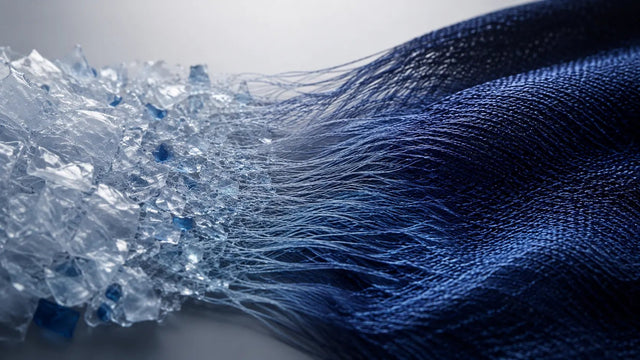
Used bottles are collected and sorted by colour and grade. They are washed to remove labels, caps, glue and food residue. What remains is shredded into small flakes. Those flakes are dried, melted, and pushed through fine nozzles to form a continuous filament. That filament is spun into yarn, and the yarn is woven into cloth. The cloth is then printed, cut, and finished into a tie by hand in Italy.

The result does not look or feel like a plastic bottle. It takes print beautifully, holds a knot, and has the quiet weight of a proper tie. It feels, frankly, like silk. That closeness did not happen by accident. We made prototype after prototype, and we keep refining the cloth as recycling technology improves, so each generation feels better than the last. Most people cannot tell it apart from a conventional printed silk tie until we explain what it is. That is the point. The material should earn its place on its own terms, not as a compromise you accept for the sake of conscience.
Because each tie is then made by hand in Italy, it lasts. These are not seasonal pieces. They are built to be worn for years, which is its own form of sustainability and the reason we are comfortable saying there is no trade-off in quality here.
What rPET is, and what it is not
It helps to be precise, because this is a field crowded with loose claims.
rPET is recycled polyester. It is made from plastic that already existed, rather than from new petroleum drawn from the ground. Producing it uses meaningfully less energy and creates fewer greenhouse gas emissions than making virgin polyester. Life-cycle studies put the energy saving in a broad range, often cited between roughly 30 and 50 percent, with some analyses higher, depending on the recycling method and how the study draws its boundaries. The honest summary is this: the savings are real and well documented, and the exact figure depends on the source.
rPET is not silk. It has come remarkably close to the feel of silk, and we are proud of that, but it is a different fibre and we will always tell you so. We make silk ties too, from silk woven in Como, and we are open about the distinction. rPET is also not a material that disappears when you are done with it. It is plastic. Recycling slows the journey of that plastic. It does not end it.
Saying both of those things out loud is how we would want a brand to talk to us.
Why the fabric is certified
Anyone can print “recycled” on a label. The word, on its own, is close to meaningless. That is why we source our cloth from mills whose recycled fabric is certified to the Global Recycled Standard, usually shortened to GRS.
GRS is run by Textile Exchange, a non-profit, and verified by independent third-party auditors. It does a few things that matter. It confirms the recycled content is genuine and tracks it through every stage of the supply chain, from the recycled input onward, so the claim cannot be quietly diluted along the way. It sets social criteria covering fair labour and worker safety at the facilities involved. And it restricts the chemicals that can be used in processing.
The certification sits with the fabric and the suppliers who make it, which is exactly where it belongs. The recycled content is verified at source, by people whose job is to check it, before the cloth ever reaches our workshop. We chose those suppliers precisely because the claim holds up to an outside audit. If you are going to ask a customer to believe a sustainability claim, that is the least it should rest on.

The honest part: microplastics and the limits
A piece about recycled fabric that skipped this section would not deserve your trust, so here it is plainly.
All synthetic textiles, recycled or virgin, can shed tiny plastic fibres, especially in the wash. This is the microplastics problem, and recycled polyester does not solve it. A tie, though, is one of the lowest-risk garments here. It is washed rarely, if ever, and when it does need attention the rPET cloth wipes clean more easily than silk. That does not make the issue disappear, and we are not going to claim it does. It exists. We simply think a garment you almost never wash is a sensible place for this material to be.

There is a second limit worth naming. Mechanical recycling cannot be repeated forever. Each cycle can shorten the polymer, so a bottle does not become a tie that becomes a bottle again in an endless loop. rPET is better described as a way of extending the useful life of plastic that has already been made, and keeping it out of landfill and waterways for longer, rather than as a perfectly closed circle.
We think recycled plastic is the better choice. We do not think it is a clean conscience in fabric form. Those are different claims, and the difference is exactly where greenwashing usually hides.
Why we still chose it
Given the limits, why make ties from it at all?
Because the alternative we were replacing was virgin polyester, and on that direct comparison rPET is the clearly better option. It draws on plastic that already exists rather than demanding new oil. It diverts bottles from waste streams. It carries a lower energy and emissions footprint. And, unlike many sustainable materials, it does not ask you to settle for a worse product. The tie is genuinely good.
There is also something fitting about the object itself. A tie is a small, considered thing you keep for years and wear deliberately. Turning a throwaway bottle into something that lasts and means something is a quiet kind of argument against disposability. Several of our recycled plastic designs have been worn by Prince William, which we will come to in a separate piece, but the material does not need a famous wearer to make the case. The case is in the cloth.

A tie that carries a little further
There is one more thing the material does, and it sits at the centre of why Wilmok exists rather than at the end of a sales page.
Every Wilmok purchase supports food aid for underprivileged children in Nepal. A recycled plastic tie therefore does two modest things at once. It keeps some plastic in use for longer, and it puts food on a table for a child who needs it. Neither claim is grand. Both are true, and both are the reason we do this.
That is the whole of it. rPET is recycled plastic, mostly from bottles, spun into yarn and woven into cloth that is independently certified at source, then finished by hand so it lasts. It is better than virgin polyester and honest about its limits. If that is the kind of thing you want on under your collar, our recycled plastic ties are here, and now you know exactly what they are made of.
0 Comments
There are no comments for this article. Be the first one to leave a message!